Power for canon
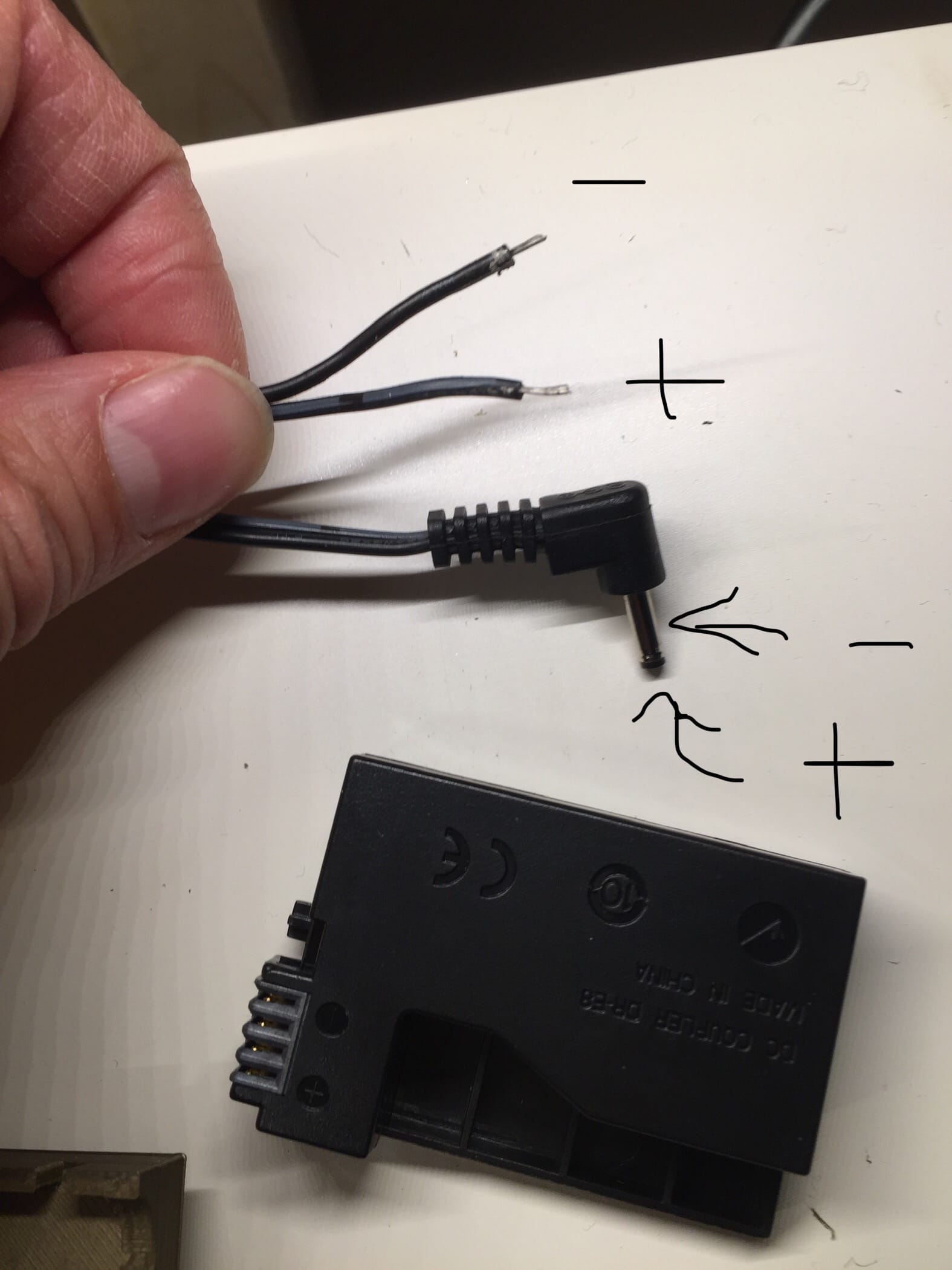
Plug
Dummy adapter
+ = 7.2v-= GND
DR-E8
https://www.aliexpress.com/item/10Sets-Lot-LP-E8-DR-E8-DRE8-DC-Coupler-CA-PS700-Cable-for-Canon-EOS-T2i/32764550901.html?spm=a2g0s.9042311.0.0.76c54c4dJ5jkItACK-E8https://www.aliexpress.com/item/10Sets-Lot-LP-E8-DR-E8-DRE8-DC-Coupler-CA-PS700-Cable-for-Canon-EOS-T2i/32764550901.html?spm=a2g0s.9042311.0.0.76c54c4dJ5jkIt10 x coupler10 x cable$33.90/lot 10pieces/lot $3.39each8.07 shipping= $41.92 about $5CDN eachWire polarity
VoltageLM2596 (7.4V)Candidate for powering Canon Rebel T2i at 7.2-7.4 voltshttps://www.thingiverse.com/thing:1810365OP Yowie Wowie • Senior Member • Posts: 1,166 Re: A question for owners of the external power supply (ACK-E8) - I tried Canon... In reply to PhotoVerse • Nov 23, 2015 Hi PhotoVerse, I did make an external battery supply for my 600D and Surface Pro, however, I damaged my 600D not long after I did this thread. After I got the repair quote, I decided I would just fix it myself, as the camera was still fully functional, apart from not being able to close the flip screen with the LCD facing inwards, and the repair quote was about the same price I had just paid for the camera + kit lens. I put the insurance money towards a great deal on a 70D body, and I have not had any battery problems since. In fact, I have never run out of battery with the 70D. I don't even own a spare. I have 5 batteries for my 600D! But now I don't use it anywhere near as much as I use the 70D. Anyway, I actually went with a high voltage lithium battery (16.8V), so I could step down for both the Surface Pro (12V) and the 600D (7.2V). It would be far safer to go with a lower voltage pack, and step the voltages up. If you get a short in your circuit, a higher voltage pack will oversupply voltage to your devices. A shorted circuit with a lower voltage pack will undersupply, which is much better, as it means that circuits generally simply won't operate, rather than burning out with over-voltage. Any battery will work. Some batteries are safer than others(ie, less likely to catastrophically fail and cause a fire). Anyway, the system goes like this: Battery pack -> switching regulator (voltage output controller) -> Canon battery coupler (DR-E8) Pretty simple. You have a battery (voltage of whatever), you connect it up to the input of the switching regulator, and the regulator output provides the camera voltage, in this case, 7.2V. If the battery is higher than 7.2V, you need a switching regulator that will step down or buck the output to 7.2V. If the battery is lower than 7.2V, you need a switching regulator that will step up or boost the voltage to 7.2V. So what does 'switching regulator' mean you may wonder? Well, it is a voltage regulator that operates by switching on and off very fast. Fast enough, so that for your DC purposes, it appears as a linear voltage rather than a waveform. But it is still a waveform, and its frequency can interfere with other components of the camera that use electromagnetic coils(motors and solenoids) if it approaches resonance. I won't try to explain the physics concepts in detail, but the wiki definition is fairly concise
Resonance - "The increase in amplitude of oscillation of an electric or mechanical system exposed to a periodic force whose frequency is equal or very close to the natural undamped frequency of the system." -wiki
In plain speak, the "amplitude of oscillation of an electrical or mechanical system" means how much the motors and solenoids in the camera vibrate when they operate. These components are controlled by a switching voltage (different coils fire up in sequence to move the rotor/actuator), which is also a waveform. It switches so fast you don't notice it, but it is there. The "periodic force" is the supply voltage waveform. So, you have a supply voltage waveform, and a motor control waveform. At certain supply voltage frequencies, you approach resonance, and the vibrations can get out of control, potentially resulting in mechanical strain and failure. The vibrations exponentially increase as you approach resonance, and similarly drop off just as fast as you move away. The problem is noticed in devices like cameras as a 'buzzing' noise from the cameras motors. The solution is changing the input frequency to something different than the resonant frequency. But unless you have a very nice oscilloscope, an appetite for opening up your gear, and the ability to analyse and design circuits, all you can do is try different regulators with different frequencies if the first one you buy causes buzzing. The other thing to consider is current (amps). When you step-up a voltage, you proportionally lose current (Power = Voltage*Current). But you can get lithium cells with insane current discharge ability, far exceeding what the cameras demand, even stepping up from a single cell. Lithium packs require a specialised charger, called a "balance" changer. It monitors each individual cell and balances them during charging. A decent RC battery charger is typically able to charge all kinds of battery chemistry. You can get them from places like HobbyKing. Likewise with the regulators. You can also get all kinds of monitoring and safety circuits, so that the power supply will be cut off if anything starts to go wrong, protecting your gear. Keep in mind, I bear no responsibility for what you choose to do, and if you burn your house down Regards, Yowie